

Live beta 50% oFf

so i did a thing...

I had this crazy idea: what if you could build instruments out of simulated physical masses and springs in 3D space, connect them, manipulate them, and just... hear what happens?

meet Anukari.

A software synthesizer and effects processor based on a fully interactive 3D physics simulation.

Ah-Noo-Karr-Ee

Anukari is built entirely on real-time physics simulation. You can build structures that ring, vibrate, interact, and feed back into one another. Excite them with mallets, bows, your own audio, and more. And explore sonic palettes that are wildly out of this world.

What does it sound like? Whatever you want. Sometimes it's subtle, and sometimes not so subtle. Does it create time paradoxes? Will you tear the fabric of space-time? Hard to tell... but Anukari invites you to find out.

calling all sonic adventurers.

If precision tools like Serum answer the question, “How do I get that sound?” Anukari asks, “What happens if I do THIS?”

Built for the intrepid sonic explorer, Anukari’s 3D physics playground dares you to build, break, warp, and discover sounds that you never could have imagined.

build the absurd.

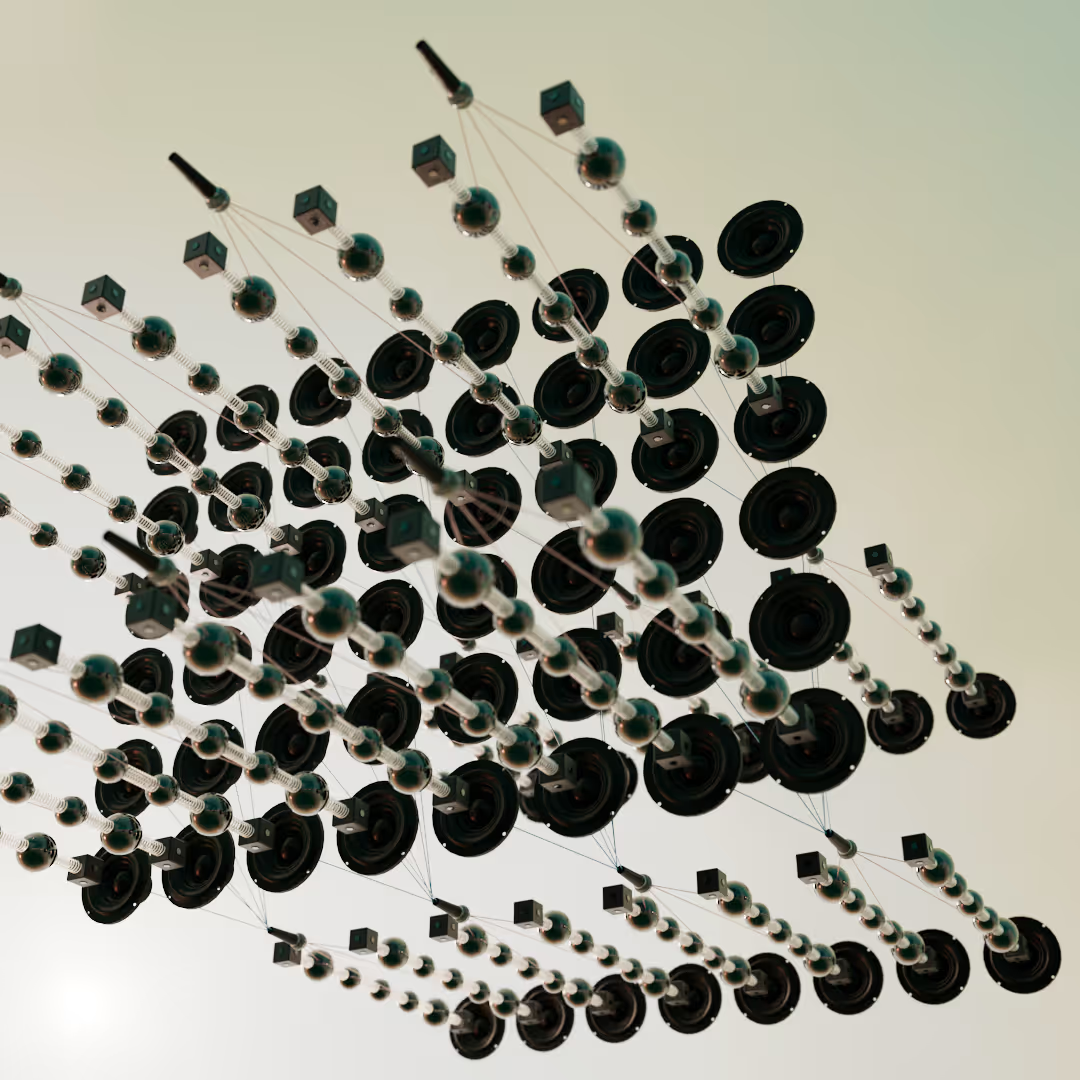
Wire together masses and springs, drag in some exciters and mics, then use your MIDI keyboard or your own audio to make noise.

For the more tactile-minded, just grab a mass with your mouse, pull, and let go. Keep it simple and controlled or build sprawling systems of hundreds of objects and catapult yourself into another dimension!

modulate all the things.

In addition to the basic physics objects, there are a ton of options for modulation:

Powerful sample-accurate LFOs which can operate all the way up to audio frequency for FM. MIDI-triggered envelopes. Envelope followers. And of course, every MIDI control source, as well as DAW automation parameters.

The modulation matrix is built to be simple but powerful. It's displayed via physical connections in the 3D world and nearly every parameter can be modulated.

push it. further.

With a full 3D physics simulation, you can build some pretty weird stuff. Try a loose chain of masses tied down only at one end, struck by three mallets in different directions, and watch it spin wildly out of control.

Push the physics past their limits and see how things explode. Create a loose, tangled mass of springs and excite it with white noise. And with full MPE support and Microtuning via MT-ESP, you're fully equipped for a full sonic expedition. What will happen? No one knows. It's up to you to find out!

oh yeah... visuals.

As if the sound wasn't enough, Anukari also vibrates, spins, and flexes visually as you play it. And with custom skyboxes, audio-reactive shaders, and the ability to import your own 3D models, you can create your own world to project at live shows, share on social media, or just... live in.

Try Anukari Free

so like...  how does it work?

fiber smart record circle
Basic Building blocks

Mass: The silver metal spheres can move freely in any direction, according to the forces imparted upon them by springs, mallets, or other exciters. Their mass and damping are adjustable.

Anchor: The dark metal boxes are fixed in position and are used to tie down parts of the instrument that you don't want to move.

Spring: Free masses and/or anchors can be connected by springs that pull them together or push them apart based on whether they are stretched or squished. Their stiffness and neutral length are adjustable.

fiber smart record circle
exciters

Mallet: Strike target masses with an impact force in the direction that the mallet is pointed.

Oscillator: Apply a vibrating force to target masses based on a typical analog oscillator shape (sine, square, saw, noise, etc.) with an ADSR envelope.

Plectrum: Pluck target masses, pulling them back in the direction of the plectrum and releasing them after a short period of time.

Bow: Apply a harmonic vibrating force to target masses based on a model of "negative feedback" with an ADSR envelope. Can also be used for flute-like sounds.

Audio Signal: Apply a force to target masses based on the value of an external (or internal!) audio signal in the direction of the exciter. Can optionally be gated by a MIDI note with an ADSR envelope.

fiber smart record circle
microphones

Directionality: Microphones are more sensitive to vibration in the direction they are pointed. Their rotation can be modulated for Leslie-style effects.

Compression: Each microphone has a simple built-in compressor, making it easy to work with instruments that have a large dynamic range. Plus, over-compressing can produce interesting distortion.

Delay Lines: By default, microphones are mixed into the audio output. But they can also be attached to audio signal exciters via delay lines to feed back their signal into the physics system. The delay time can be modulated!

fiber smart record circle
Modulators

Visual Matrix: Anukari lets you connect modulators to objects by simply dragging green modulation connections between them so you can see what's modulated visually.

‍LFO: Anukari's LFOs provide the basic waveforms you'd expect, along with tempo sync and retriggering. They are sample-accurate and can oscillate at 0.01 Hz all the way up to 20 kHz. And they are recursive, so feedback with other LFOs for FM synthesis is allowed.

MIDI Control: All MIDI control signals are available as modulation sources, including velocity, pitch bend, continuous control, channel pressure, and aftertouch. The exponential smoothing amount for the input signal is configurable.

‍DAW Automation: Automation lanes in your DAW of choice can be mapped as modulation sources controlling any parameter.

‍Trigger Envelope: MIDI notes can be configured to trigger simple ADSR envelope automations.

Envelope Follower: Connect an envelope follower to a microphone and the amplitude of an internal audio signal can be turned into a modulation signal.

fancy tickled? you're not alone.

Anukari is currently in public beta, and a bunch of recklessly curious creators can't stop talking about it.

“Each instance is its own Newtonian universe ready to create harmony, chaos or a bit of both. The most open ended synthesizer there's ever been.”

"I just don’t understand how you’ve made this work without constant crashes or audio drop outs or anything. I’m sort of determined to crash it at this point"

"Opens so much creative potential for being off or a little weird, or out of the realm of what most plugins allow you to do"

start building with Anukari today

GET ANUKARI

stay in-the-know

Anukari is always evolving, and I'm exploring new features constantly. To keep up with all things Anukari, you can subscribe to the newsletter!

SUBSCRIBED!
Oops! Something went wrong.
© 2026 Anukari LLC